Choosing the right studio headphones is an important part of building a music production setup. Whether you record vocals, produce beats, mix songs or run a home studio, your headphones influence how you hear and monitor your sound.
However, not every studio headphone is designed for the same purpose.
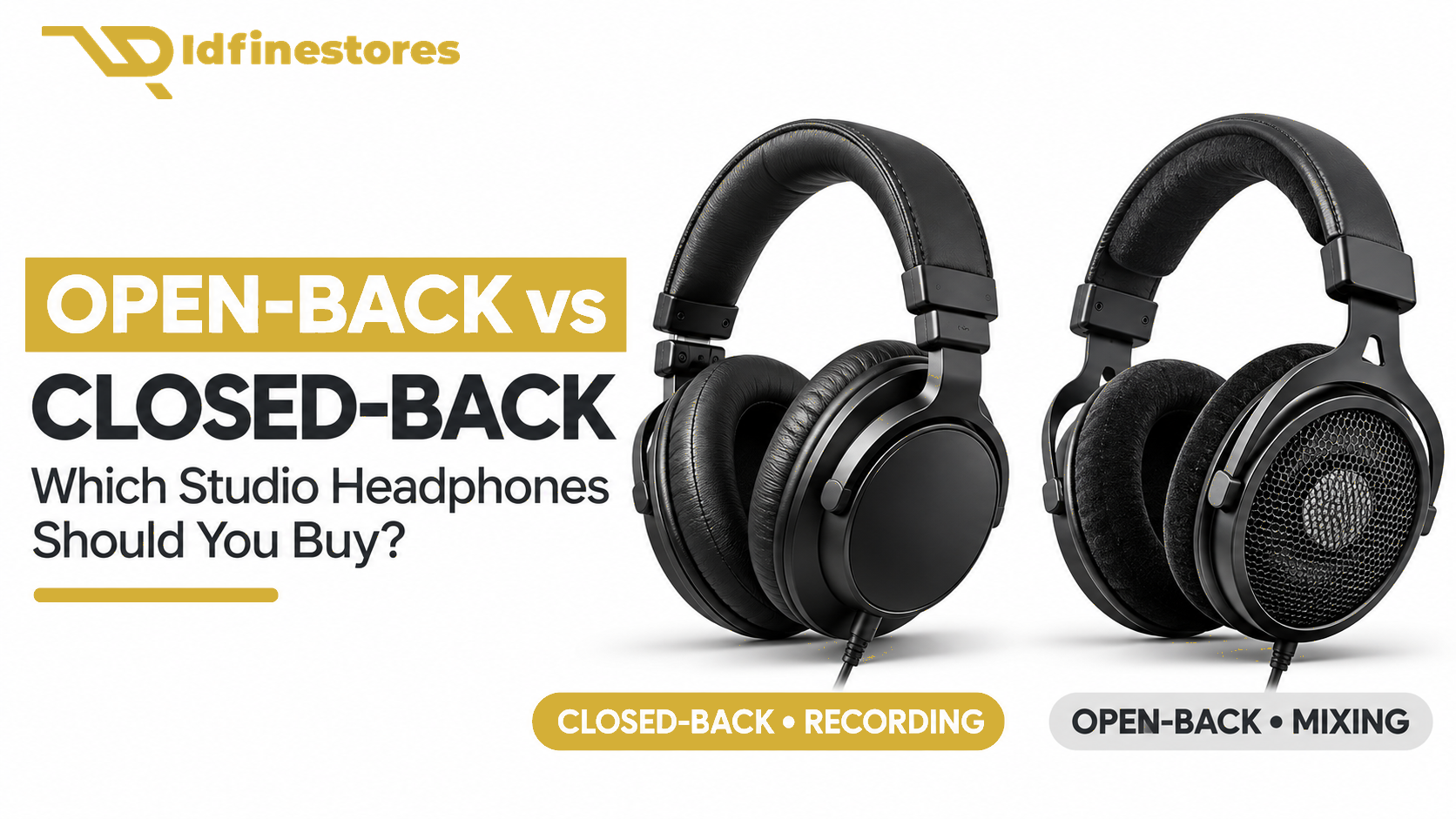
Some headphones are built to isolate sound during recording. Others allow more sound to pass through their ear cups and are often preferred for critical listening.
This brings us to an important question: Should you buy open-back or closed-back studio headphones?
In this guide, we explain the differences, their advantages, their limitations and what to consider before buying. We will also help you understand headphone impedance, audio interface compatibility and how to choose a pair that suits your studio budget.
If you are planning to buy studio headphones in Nigeria, this guide will help you make a more informed decision.
1. What Are Studio Headphones?
Studio headphones are designed for audio monitoring, recording, editing, mixing and music production.
Unlike some ordinary consumer headphones, which may boost bass or treble to make music sound more exciting, studio headphones are often designed to provide a more balanced listening experience.
This is important because producers and recording engineers need to hear different parts of a song clearly.
For example, you need to identify:
- Whether the vocals are clear and properly balanced.
- Whether the bass is overpowering other instruments.
- Whether the kick drum and bassline work together.
- Whether background noise is present in a recording.
- Whether effects such as reverb and delay are too strong.
- Whether instruments are positioned properly in the stereo image.
Studio headphones are available in different designs. The two main types are open-back and closed-back.
Understanding their differences will help you choose the right equipment.
2. What Are Closed-Back Studio Headphones?
Closed-back headphones have solid outer ear cups that enclose the headphone drivers.
This design helps contain sound inside the headphones and reduces the amount of external noise entering your ears.
As a result, closed-back headphones are particularly useful for recording vocals and instruments.
Advantages of closed-back headphones
They help reduce microphone leakage.
Imagine recording vocals while listening to an instrumental through your headphones.
Some sound can escape from the ear cups and enter the recording microphone. This is called headphone bleed.
Closed-back headphones help reduce this problem. They are therefore a practical choice for vocal recording.
They provide better isolation.
Closed-back headphones can reduce distractions from conversations, fans, computer noise and other sounds around your recording area.
This is especially useful in home studios where the room may not be acoustically treated.
They are suitable for recording instruments.
Whether you are recording vocals, guitar, keyboard or other instruments, closed-back headphones allow performers to monitor the backing track while reducing unwanted sound leakage.
They are useful in shared environments.
Because they generally leak less sound, closed-back headphones are more suitable when other people are working nearby.
Limitations of closed-back headphones
Closed-back headphones are not perfect.
Some models can produce a more enclosed listening experience. Others may emphasise particular frequencies because of their design and tuning.
They can also become warm during long recording sessions, depending on the ear pads and fit.
However, these limitations do not mean that closed-back headphones are unsuitable for mixing. A well-designed closed-back model can also be useful for production and critical listening.
3. What Are Open-Back Studio Headphones?
Open-back headphones have outer ear cups with openings, perforations or mesh panels.
These allow air and sound to move through the outer part of the headphones.
Unlike closed-back designs, open-back headphones do not attempt to seal sound inside the ear cups.
Many users prefer their more spacious listening presentation, particularly when evaluating recordings and making mixing decisions.
Advantages of open-back headphones
They can provide a more spacious sound.
Open-back headphones often create a wider and more natural impression of space.
This can be useful when evaluating stereo placement, ambience and the relationship between instruments.
They can be useful for mixing.
Some open-back models provide a balanced and detailed listening experience. This can help producers evaluate vocals, instruments, effects and other elements of a mix.
They can feel less enclosed.
Because air can move through the ear cups, some users find open-back headphones more comfortable during extended listening sessions.
However, comfort depends on the individual headphone, ear pads, fit and personal preference.
Limitations of open-back headphones
Open-back headphones also have disadvantages.
- Sound can escape from the ear cups and disturb people nearby.
- External noise can enter the headphones.
- They offer limited isolation.
- Sound leakage can enter a nearby recording microphone.
For this reason, open-back headphones are generally not the first choice for vocal recording.
4. Open-Back vs Closed-Back: What Is the Difference?
Here is a simple comparison to help you understand their main differences.
| Feature | Closed-back | Open-back |
|---|---|---|
| Ear cup design | Enclosed outer cups | Vented or mesh outer cups |
| Sound leakage | Generally lower | Generally higher |
| Noise isolation | Generally better | Generally limited |
| Vocal recording | Usually preferred | Usually unsuitable near microphones |
| Mixing | Depends on model and tuning | Often useful for critical listening |
| Sound presentation | Can feel more enclosed | Often feels more spacious |
| Home studio use | Excellent for tracking | Useful in quiet mixing environments |
The important thing to understand is that headphone design alone does not determine sound quality.
A good closed-back headphone can be a reliable mixing tool. Likewise, an open-back headphone is not automatically accurate simply because its ear cups are open.
You should also consider frequency response, comfort, build quality and how the headphones work with your audio interface.
5. Why Are Closed-Back Headphones Better for Recording Vocals?
Imagine that you are recording a singer in your home studio.
The singer needs to hear the instrumental, timing and other monitoring signals while performing.
You connect the headphones to your audio interface and play the backing track.
If the headphones leak too much sound, the microphone may capture part of the instrumental playing through the ear cups.
This can introduce unwanted sound into the vocal recording.
Closed-back headphones help minimise this problem because their enclosed design reduces sound leakage.
When choosing recording headphones, consider the following:
- Good passive isolation.
- Comfortable ear pads.
- A secure fit around the ears.
- A suitable cable length.
- Replaceable ear pads where possible.
- Enough volume from your audio interface without excessive gain.
A good recording headphone should allow the performer to hear clearly without turning the volume up unnecessarily.
6. Are Open-Back Headphones Better for Mixing?
Open-back headphones can be excellent for mixing, but there is an important distinction.
Mixing requires you to evaluate several elements of a song, including:
- Vocal clarity.
- Instrument separation.
- Stereo width.
- Reverb and delay.
- Bass balance.
- High-frequency detail.
- The relationship between instruments.
Some open-back headphones provide a spacious listening presentation that can help with these decisions.
However, open-back does not automatically mean accurate.
A headphone can have an open design and still have an uneven frequency response.
For serious mixing, consider the headphone’s tuning, frequency response, distortion performance and how consistently it reproduces sound.
You should also remember that headphones do not completely replace studio monitors.
Studio monitors reproduce sound into your room, while headphones deliver sound directly to your ears. Both provide different listening perspectives.
If you mix primarily on headphones, learn how your chosen pair reproduces bass, vocals and high frequencies.
Also, check your finished mixes on other playback systems.
7. Can You Use One Pair of Headphones for Recording and Mixing?
Yes. Many home-studio owners start with one good pair of closed-back studio headphones.
They use the same headphones for recording, editing, monitoring and general production work.
This is a practical decision, particularly when you are working with a limited budget.
A good closed-back headphone can also be used for mixing, provided you understand its sound characteristics and cross-check your mixes on other playback systems.
However, if you record vocals frequently and also handle detailed mixing, owning both types can be useful.
A practical setup could look like this:
Closed-back headphones: Use them for vocal recording, performer monitoring and tracking instruments.
Open-back headphones: Use them for mixing, editing and critical listening in a quiet environment.
You do not need to purchase both immediately. Start with the type that supports your most frequent studio activity.
8. What Do 32Ω, 80Ω and 250Ω Mean on Studio Headphones?
When shopping for studio headphones, you may notice specifications such as:
- 32 ohms (32Ω).
- 80 ohms (80Ω).
- 250 ohms (250Ω).
These figures describe headphone impedance.
Impedance is an electrical characteristic that affects how much voltage a headphone requires from the device driving it.
In simple terms, higher-impedance headphones generally need more voltage from the headphone output to reach the same listening level.
However, sensitivity also plays an important role.
32Ω headphones
These are generally easier to drive from many portable devices, laptops and audio interfaces.
They can be a practical option if you want headphones that work across different devices.
80Ω headphones
These are common in studio headphone ranges.
They can work well with many audio interfaces and home-studio setups. However, you should still check the output capability of your particular interface.
250Ω headphones
These may require more voltage from the headphone output to achieve a suitable listening level.
Some audio interfaces can drive them comfortably, while others may not provide enough volume or headroom for every headphone model.
Important: Higher impedance does not automatically mean better sound quality.
Do not buy a 250Ω headphone simply because the number is higher. Check your audio interface specifications and the headphone’s sensitivity before purchasing.
9. What Is Headphone Sensitivity, and Why Does It Matter?
Sensitivity describes how efficiently headphones convert an electrical signal into sound.
It is commonly expressed in decibels relative to a specified input, such as dB SPL per milliwatt or dB SPL per volt.
Two headphones with the same impedance can produce different listening levels because their sensitivities may differ.
Therefore, impedance alone is not enough to determine whether your audio interface can drive a headphone properly.
Before buying, check:
- The headphone impedance.
- The headphone sensitivity.
- The maximum output capability of your audio interface.
- Whether you can achieve a comfortable listening level without excessive volume.
If your headphones are too quiet even when the interface output is high, you may need a suitable headphone amplifier or a different headphone model.
10. Should You Buy Wired or Wireless Studio Headphones?
For serious recording and music production, wired headphones are generally the more practical choice.
A wired connection avoids the additional processing and potential latency associated with many Bluetooth listening modes.
Latency is the delay between an audio signal being played and the sound reaching your ears.
During vocal recording, noticeable delay can make it difficult for performers to stay comfortable and in time.
Wireless headphones can still be useful for casual listening, reference checking and everyday use.
However, Bluetooth headphones should not automatically be treated as the best option for recording and monitoring.
If you are buying headphones mainly for studio production, prioritise a reliable wired connection.
11. Can Studio Headphones Replace Studio Monitors?
No. Studio headphones are useful, but they do not completely replace studio monitors.
Headphones deliver sound directly to your ears, while studio monitors reproduce sound into the room.
This changes how you perceive stereo imaging, bass response and the interaction between different sounds.
A good production workflow can use both.
Use headphones for:
- Recording and monitoring.
- Detecting small details.
- Editing audio.
- Checking background noise.
- Working when speakers are not practical.
Use studio monitors for:
- Evaluating the overall mix.
- Checking how instruments work together in the room.
- Making balance decisions.
- Cross-checking stereo image and low-frequency response.
If you work in a small home studio, headphones can be particularly useful. However, you should still check your finished mixes on different playback systems.
12. What Should Beginners Buy First?
If you are building your first home studio, do not spend your entire budget buying multiple headphone types.
Start with your actual production needs.
If you record vocals frequently: Buy a comfortable closed-back studio headphone with good isolation.
If you mainly produce beats and instrumentals: Choose a well-reviewed, balanced studio headphone that works with your audio interface. A closed-back model can be a practical starting point.
If you mainly mix and edit in a quiet room: Consider an open-back model with a reliable frequency response.
If you record and mix regularly: Start with a good closed-back model and consider adding open-back headphones later.
You do not have to buy the most expensive headphones to start producing good music.
What matters is choosing equipment that suits your workflow and allows you to make reliable listening decisions.
13. Common Mistakes to Avoid When Buying Studio Headphones
Before choosing your next pair, avoid these mistakes.
Buying based only on brand name
A recognised brand does not automatically mean a particular headphone is suitable for your recording or mixing needs.
Assuming more bass means better studio sound
Headphones with heavily boosted bass can make it difficult to judge the actual low-frequency balance of your mix.
Buying high-impedance headphones without checking your interface
A headphone that requires more power may not reach a suitable listening level with every interface.
Using open-back headphones for vocal recording
Sound leakage can enter your microphone and affect the recording.
Assuming open-back headphones are always better for mixing
Frequency response, comfort, accuracy and familiarity with the headphones matter more than the design alone.
Ignoring comfort
If your headphones become uncomfortable after 30 minutes, they may become a problem during longer production sessions.
Mixing at excessively high volumes
High listening levels can cause listening fatigue and increase the risk of hearing damage. Work at sensible levels and take regular breaks.
14. Frequently Asked Questions
Are closed-back headphones good for music production?
Yes. Closed-back headphones are useful for recording vocals, monitoring instruments, editing and general production. Many can also be used for mixing if their sound characteristics are suitable.
Are open-back headphones good for beginners?
They can be, especially if you work in a quiet environment and primarily mix or edit. However, beginners who record vocals should generally start with closed-back headphones.
Can I record vocals with open-back headphones?
It is possible, but generally not recommended when using a microphone that can pick up headphone leakage. Closed-back headphones are usually the safer option.
Are 80Ω headphones better than 32Ω headphones?
Not necessarily. The difference is electrical impedance, not a direct measurement of sound quality. Your audio interface’s output capability and the headphone’s sensitivity matter.
Do I need a headphone amplifier?
Not always. Many audio interfaces can drive common studio headphones. A separate headphone amplifier may be useful if your current headphone output cannot provide sufficient volume or headroom.
Can I mix a professional song using only headphones?
Yes, it is possible to produce professional mixes using headphones. However, you need to understand their sound characteristics and cross-check your work on other playback systems.
15. Where Can You Buy Studio Headphones and Music Production Equipment in Nigeria?
Choosing the right headphones is only one part of building a reliable recording setup. You also need equipment that works together and suits your budget.
This is where choosing the right technology store matters.
At Idfinestores, we make it easier for musicians, music producers, recording engineers and home-studio owners to find the equipment they need without making uninformed buying decisions.
We are an online technology store focused on premium gadgets and professional music studio equipment. Our goal is to help customers understand what they are buying, compare suitable options and choose equipment that serves their actual needs.
Why Buy Your Music Studio Equipment from Idfinestores?
1. A specialist technology store, not just another online seller
We understand that buying studio equipment requires more than looking at a product picture and price.
You need to know what the equipment does, how it connects to other devices and whether it is suitable for your production workflow.
Our educational approach helps you make those decisions with more confidence.
2. Affordable options for different studio budgets
Building a music studio can be expensive. However, you do not always need the most expensive equipment to get started.
At Idfinestores, we focus on offering competitively priced equipment and options for different budgets.
Whether you are starting a home studio, upgrading your recording setup or expanding an existing production environment, you can explore suitable products without assuming that professional equipment must always be beyond your budget.
3. Product guidance before you buy
Not sure whether you need open-back or closed-back headphones?
Wondering whether a particular headphone will work with your audio interface?
Our team can help you understand product specifications and make a more suitable selection before placing an order.
We want you to buy equipment that fits your needs, not equipment you will struggle to use.
4. Carefully selected equipment and clear product information
We focus on quality-conscious product selection and clear descriptions.
Our aim is to help customers understand what they are purchasing, including important specifications, compatibility and intended use.
5. Support beyond the purchase
Our relationship with customers should not end when an order is delivered.
We provide customer support to help with product enquiries and post-purchase concerns in line with our store policies.
6. Convenient shopping and delivery across Nigeria
You can explore our catalogue online, make enquiries and place your order without needing to visit a physical shop.
We provide delivery arrangements for customers across Nigeria, with applicable delivery terms shown during the buying process.
Shop Studio Headphones and Music Production Equipment at Idfinestores
Whether you need closed-back headphones for vocal recording, open-back headphones for critical listening, studio monitors, audio interfaces, microphones or other production equipment, Idfinestores is here to help you make a more informed purchase.
Do not spend money on equipment simply because it is popular. Understand what you need, compare your options and choose equipment that works for your studio.
Explore our music studio equipment collection and shop your studio headphones at Idfinestores.
Idfinestores — Where Tech Meets Excellence.