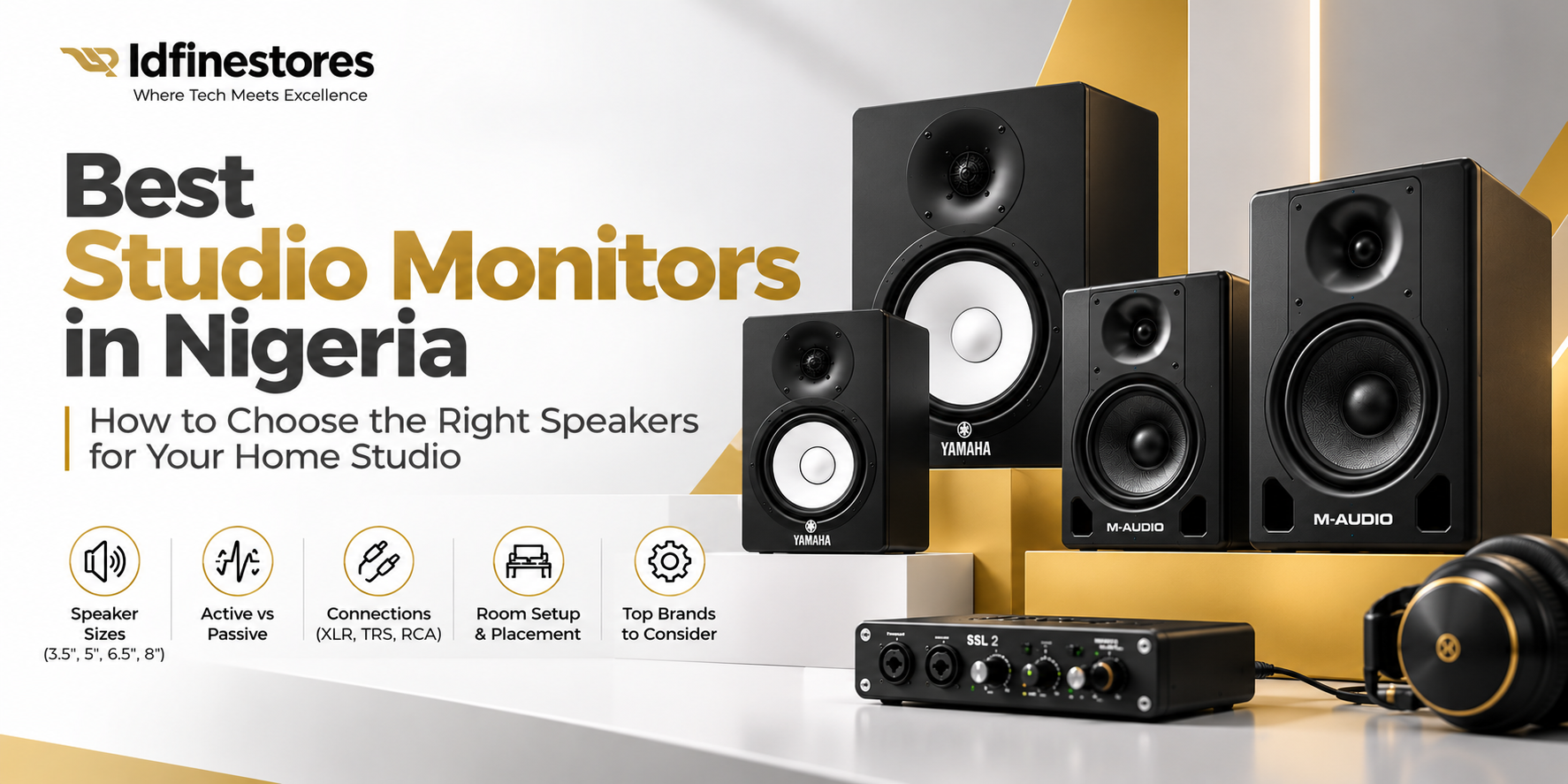
Choosing the right studio monitors is one of the most important decisions when building a home recording studio. Whether you produce Afrobeats, Gospel, Hip-hop, R&B, Amapiano or other music genres, the speakers you use can influence how you hear and mix your music.
However, buying studio monitors is not simply about choosing the biggest speakers or the most expensive brand. You need to consider your room size, listening environment, music production needs, audio interface and budget.
A pair of studio monitors that works well in one studio may not be the best choice for another.
At Idfinestores, we understand that choosing professional audio equipment can be confusing, especially when you are building your first studio. That is why we provide product information and access to knowledgeable music and audio engineers who can help customers select suitable equipment and understand how to set it up.
In this guide, we explain what studio monitors do, how to choose the right size, which features to consider and how to get the best performance from your speakers.
What Are Studio Monitors?
Studio monitors are speakers designed for music production, recording, mixing and audio monitoring.
Unlike ordinary consumer speakers, which may emphasise bass or treble to make music sound more exciting, studio monitors are designed to provide a more balanced and detailed representation of audio.
This helps producers and sound engineers hear different elements of a recording more clearly.
For example, when mixing a song, you need to hear:
- The relationship between the kick drum and bass.
- Whether vocals are too loud or too quiet.
- The clarity of instruments.
- Whether the high frequencies sound harsh.
- How the different sounds sit together in a mix.
Studio monitors help you make better-informed mixing decisions.
However, even good studio monitors cannot correct every problem in a recording. Your room, speaker placement and listening position also affect what you hear.
1. Studio Monitors vs Ordinary Speakers: What Is the Difference?
Many beginners wonder whether they can use ordinary home speakers for music production.
Although ordinary speakers can play music, they are not necessarily designed for accurate audio monitoring.
Here are the main differences.
Studio monitors
- Designed for detailed audio monitoring.
- Help reveal problems in a recording or mix.
- Commonly offer balanced sound reproduction.
- Often provide professional audio connections.
- Designed for recording, mixing and production environments.
Ordinary consumer speakers
- Often designed primarily for music listening and entertainment.
- May emphasise bass or high frequencies.
- May include sound enhancement features.
- Are not always suitable for making accurate mixing decisions.
This does not mean ordinary speakers are useless. You can use them to check how your music sounds on everyday playback systems.
However, a suitable pair of studio monitors gives you a more useful reference when producing and mixing music.
2. How to Choose the Right Studio Monitor Size
One of the most common mistakes buyers make is choosing studio monitors based only on their woofer size.
The right size depends on your room, listening distance, acoustic environment and production requirements.
3.5-inch and 4-inch studio monitors
Smaller studio monitors can be useful for compact workspaces and small home studios.
They may suit:
- Bedroom producers.
- Podcast and content creators.
- Beginners building a small recording setup.
- People working in limited spaces.
However, smaller monitors generally have less low-frequency extension than larger models. You may need headphones or another reference system to check the deepest bass frequencies.
5-inch studio monitors
Five-inch monitors are a popular starting point for many home recording studios.
They can provide a useful balance between size, bass response and workspace requirements.
They may suit:
- Music producers.
- Recording artists.
- Home studio owners.
- People mixing vocals and instrumentals.
- Producers working in smaller rooms.
If you are building a home studio and have limited space, a suitable pair of 5-inch monitors is worth considering.
6.5-inch studio monitors
Six-and-a-half-inch monitors can provide more low-frequency capability than many smaller models.
They may suit producers who need more bass detail and have enough space to position the speakers properly.
However, larger speakers do not automatically produce more accurate results in a small or poorly arranged room.
8-inch studio monitors
Eight-inch monitors are worth considering when you need greater low-frequency capability and have a suitable listening environment.
They may be useful for:
- Music producers working with bass-heavy genres.
- Larger home studios.
- Advanced mixing environments.
- People who need more low-frequency detail.
Before choosing an 8-inch model, consider your room dimensions, listening distance and acoustic treatment.
Important: Bigger is not always better. A well-positioned pair of suitable smaller monitors can be more useful than oversized speakers in an unsuitable room.
3. Active vs Passive Studio Monitors: Which Should You Buy?
Studio monitors generally come in two main types: active and passive.
Understanding the difference helps you choose equipment that works with your studio setup.
Active studio monitors
Active monitors have built-in power amplification.
This means you can connect them to a suitable audio source without purchasing a separate external power amplifier.
Many home studio monitors are active.
They are often convenient for producers building a recording setup because the amplification is already included.
Passive studio monitors
Passive monitors require an external power amplifier to operate.
The amplifier must be compatible with the speakers’ power and impedance requirements.
This type of system requires additional equipment and careful matching.
For many beginners and home studio owners, active studio monitors are a straightforward option.
However, the right choice depends on your existing equipment and intended setup.
4. Which Studio Monitor Brands Should You Consider?
Different brands offer different designs, features and price ranges. The best choice depends on your budget, listening preferences and studio requirements.
Here are some brands worth exploring.
M-Audio
M-Audio is a recognised name in home recording and music production equipment.
Its studio monitor range includes options for producers setting up home studios and project studios.
The BX series is worth considering if you are comparing monitors for music production.
Yamaha
Yamaha is widely known for professional audio equipment.
Its HS series is popular among producers and engineers who want studio monitoring speakers for recording and mixing.
These monitors are worth considering when you want to build a dedicated mixing environment.
KRK
KRK studio monitors are another popular option in music production.
The Rokit series is known for its distinctive yellow woofer design and features aimed at studio monitoring.
They are worth comparing if you produce bass-heavy music or want to explore different monitor characteristics.
PreSonus
PreSonus offers studio monitors for home studios, project studios and professional audio environments.
The Eris range includes different sizes and features.
For example, the PreSonus Eris Studio 8 is an 8-inch active studio monitor with XLR, TRS and RCA connectivity.
You can explore available PreSonus monitors in the Idfinestores monitor speakers collection.
Edifier
Edifier offers different powered speaker models, including products that can suit desktop audio and selected home studio applications.
When comparing Edifier products, check the exact model specifications and intended use. Not every powered speaker is designed as a professional studio reference monitor.
Our recommendation: Do not choose a brand simply because it is popular. Compare the individual model, specifications, connectivity and suitability for your room.
“Idfinestores monitor speakers collection” t
5. What Connections Should You Check Before Buying?
Studio monitors can have different audio input connections.
Before buying, check that the speakers can connect properly to your audio interface or other audio equipment.
Common connections include:
XLR
XLR connections are widely used in professional audio equipment.
They are common on studio monitors and audio interfaces.
TRS
TRS connections are also widely used for balanced audio connections.
Many audio interfaces provide balanced TRS outputs for connecting studio monitors.
RCA
Some monitors provide RCA inputs, which are commonly found on consumer and certain entry-level audio equipment.
RCA connections are unbalanced, so cable length and electrical interference may matter more in some setups.
Why does your audio interface matter?
If you already own an audio interface, check its available monitor outputs before buying speakers.
For example, a suitable interface with balanced outputs can connect to compatible studio monitors using the correct cables.
Do not assume that every monitor uses the same cable or connector.
If you are unsure, our music equipment support team can help you understand which connections you need.
[INTERNAL LINK 2: Link “audio interfaces and sound cards” to your existing sound-card article:
6. How to Position Studio Monitors Correctly
Buying suitable studio monitors is only part of the process. Correct positioning also matters.
Poor placement can affect bass response, stereo imaging and the way you hear different frequencies.
Here are some useful starting points.
Create an equilateral listening triangle
Position your left and right monitors so that they form two points of a triangle.
Your listening position should form the third point.
Ideally, the distance between the two monitors should be approximately equal to the distance from each monitor to your listening position.
This arrangement helps create a more balanced stereo image.
Position the tweeters near ear level
The high-frequency drivers, known as tweeters, should generally be positioned around your ear level when you are seated in your normal listening position.
This helps you hear the monitors as intended.
Angle the monitors towards your listening position
Point both monitors towards your listening position.
This helps create a more consistent stereo image.
Avoid placing monitors directly in corners
Corners and nearby walls can influence low-frequency response.
Where possible, follow the manufacturer’s placement recommendations and experiment with positioning to find a balanced result.
Some monitors are designed for placement closer to a wall, while others may require more space.
Use suitable stands or isolation pads
Placing monitors directly on a desk can introduce unwanted vibrations and reflections.
Suitable monitor stands or isolation pads can help reduce these effects.
For more detailed placement guidance, read
7. Does Your Room Affect How Studio Monitors Sound?
Yes. Your room has a significant influence on what you hear.
Even expensive studio monitors can produce misleading results if the room has severe acoustic problems.
For example, a room with bare walls, tiled floors and large reflective surfaces may create unwanted reflections.
Low frequencies can also build up in certain areas of the room. This can make the bass sound louder or weaker than it really is.
What can you do to improve your room?
Start with practical improvements.
- Position your monitors symmetrically.
- Avoid placing your listening position directly against a wall.
- Use suitable acoustic panels where necessary.
- Consider bass traps for low-frequency problems.
- Use curtains, rugs and soft furnishings to help manage some reflections.
- Keep the left and right sides of your listening environment reasonably balanced.
However, ordinary curtains and foam do not replace proper acoustic treatment. They can help with certain reflections, but they do not solve every room problem.
If you are unsure what your room needs, get guidance before spending money on acoustic materials.
8. Do You Need a Subwoofer for Your Home Studio?
Not necessarily.
A subwoofer reproduces lower bass frequencies that may be beyond the range of your main studio monitors.
It can be useful for producers who need to evaluate deep bass, sub-bass and low-frequency elements.
However, a subwoofer is not essential for every home studio.
Before adding one, make sure your main monitors are suitable and correctly positioned.
A poorly integrated subwoofer can make your monitoring less accurate rather than improving it.
If you are starting out, it is often better to invest in suitable main monitors and learn your listening environment first.
9. Common Mistakes to Avoid When Buying Studio Monitors
Before spending money on studio monitors, avoid these common mistakes.
Choosing the biggest speakers available
Large monitors are not automatically better. Your room and listening distance should influence your decision.
Ignoring the audio connections
Check that the monitors can connect to your audio interface or other equipment.
Buying based only on brand popularity
A famous brand does not automatically mean that every model is suitable for your studio.
Ignoring room acoustics
Your room affects how accurately you hear sound. Speaker placement and room treatment matter.
Buying one speaker when you need a pair
Many stereo monitoring setups require two monitors. Always check whether a listing is for one speaker or a pair before ordering.
Assuming all studio monitors are identical
Models differ in size, frequency response, power, connectivity and room-control features. Compare specifications before making a decision.
10. How Idfinestores Helps You Choose the Right Studio Equipment
Choosing music production equipment can be challenging, especially when different products have different technical specifications.
At Idfinestores, we understand that our customers are not simply buying speakers. They are building recording studios, improving their production environments and investing in equipment they expect to use for years.
Idfinestores is a Nigerian online technology and music equipment store focused on phones, music studio equipment, computers, gadgets and electronics.
Our brand is built around the idea that buying technology should be a clear, convenient and supported experience.
Guidance from knowledgeable music and audio engineers
One of the important things we offer is access to knowledgeable music and audio engineers who can help customers understand their equipment choices.
If you are building a home studio, you may need more than a pair of speakers.
You may also need:
- An audio interface.
- A suitable microphone.
- Studio headphones.
- Monitor cables.
- Speaker stands or isolation pads.
- Acoustic treatment.
- A suitable computer and recording software.
Our team can help you understand how these components work together and suggest suitable options based on your budget, room and intended use.
We can also guide you through connecting and setting up your studio equipment so you have a clearer understanding of how to use your system.
You do not have to know every technical detail before contacting us. Tell us what you want to achieve, what equipment you already own and what you intend to buy.
We can help you understand the next steps.
A convenient online shopping experience
You can browse the Idfinestores website, compare available products, review specifications and place your order yourself.
Our website is designed to make product discovery and ordering convenient.
If you need assistance, our customer support team is available to help with enquiries and order-related questions.
Quality-focused product selection
We understand that studio equipment is an investment.
That is why we focus on providing product information and a shopping experience that helps customers make informed decisions.
You can review the specifications, available configurations and applicable product terms before ordering.
Delivery and after-sales support
Idfinestores offers same-day delivery in Lagos where available and typically delivers nationwide within 48–72 hours, depending on the destination and order.
We also provide customer support and guidance on applicable after-sales policies.
Our aim is to make your experience easier from product selection to delivery and beyond.
[Link “Music Studio Equipment at Idfinestores” .]
[ Link “contact our music equipment support team” .]
Final Thoughts: Choose Studio Monitors That Work for Your Studio
The best studio monitors are not necessarily the biggest or most expensive. They are the monitors that suit your room, equipment, production needs and budget.
Before buying, consider the speaker size, active or passive design, audio connections, room acoustics and placement.
If you are building your first home studio, take time to understand how your audio interface, monitors and other equipment work together.
You do not have to figure everything out alone.
At Idfinestores, we are here to help you explore suitable music equipment, understand your options and get guidance from knowledgeable music and audio engineers.
Ready to improve your home studio?
Explore the studio monitor collection at Idfinestores, compare available models and contact our team if you need help choosing or setting up your equipment.
Idfinestores — Where Tech Meets Excellence.
Product availability, prices and specifications may change. Always check the current product listing and applicable terms before ordering.