When shopping for a smartphone, one specification that often influences a customer’s decision is RAM.
You may see a Samsung Galaxy advertised with 8GB or 12GB RAM, a Google Pixel with 12GB or 16GB RAM, or an iPhone delivering impressive performance despite Apple not routinely advertising its RAM capacity in its main product specifications.
But what do these numbers actually mean?
Does a smartphone with 16GB RAM automatically perform better than one with 12GB? Is 8GB still sufficient for everyday use? And why do some Samsung phones advertise RAM Plus when their physical RAM capacity remains unchanged?
These are important questions to understand before spending money on a new smartphone.
RAM contributes significantly to how a phone manages applications, multitasking and demanding operations. However, it is not the only factor responsible for performance.
In this guide, we explain how smartphone RAM works, compare 8GB, 12GB and 16GB configurations, examine Samsung Galaxy, Google Pixel and Apple iPhone memory approaches, and help you determine which option makes sense for your needs.
1. What Is RAM in a Smartphone?
RAM stands for Random Access Memory. It is the temporary working memory a smartphone uses to manage information required by the operating system and running applications.
Think of your smartphone as a working office.
Your internal storage is like a filing cabinet where documents, photographs, videos and applications are kept. RAM is like the desk where you place the files you are currently working on.
When you open WhatsApp, switch to your browser, edit a photograph or play a mobile game, your phone uses RAM to manage the information needed for those activities.
When you move between applications, the operating system manages which information should remain readily available and which applications may need to reload.
This is why RAM is particularly relevant to multitasking.
A phone with more physical RAM may have greater capacity to keep applications and their working data available. However, the actual experience also depends on the processor, software optimisation, memory management and the applications being used.
Important: RAM does not permanently store your photographs, videos or downloaded files. Those are saved in your phone’s internal storage.
2. 8GB RAM: Is It Enough for Everyday Smartphone Use?
For many people, 8GB RAM can provide a comfortable smartphone experience.
If your daily activities include messaging, social media, browsing, watching videos, taking photographs and using ordinary productivity applications, an appropriately designed 8GB smartphone may meet your needs.
Consider these everyday activities:
- Opening WhatsApp and responding to messages.
- Browsing websites using Chrome or another browser.
- Watching YouTube videos.
- Using Instagram, Facebook and TikTok.
- Taking photographs and recording videos.
- Using banking and productivity applications.
- Playing many popular mobile games.
These activities do not all demand the same amount of memory. Some applications are relatively light, while others can consume considerably more resources.
For example, switching between messaging, browsing and streaming is different from simultaneously running demanding games, editing applications and other resource-intensive software.
Who should consider 8GB RAM?
An 8GB smartphone can be a sensible purchase if you:
- Mainly use your phone for everyday communication.
- Browse the internet and use social media.
- Take photographs and record ordinary videos.
- Stream entertainment.
- Play casual games.
- Want to balance performance with your purchasing budget.
However, do not judge an 8GB smartphone by RAM alone. A device with a capable processor, efficient software and good memory management can deliver a better experience than another device with more RAM but weaker overall hardware.
3. 12GB RAM: A Strong Balance for Multitasking
If you regularly use several applications throughout the day, 12GB RAM gives you more physical memory capacity to work with.
This can be useful when switching between applications, using demanding games, editing media or performing different tasks without constantly reopening applications.
Imagine a typical working day.
You may start by replying to WhatsApp messages, open your email, browse the internet, review documents, take photographs, edit an image and return to another application.
The phone has to manage these activities while maintaining a responsive experience.
A 12GB configuration provides more memory headroom than an otherwise comparable 8GB configuration.
Who should consider 12GB RAM?
This configuration is worth considering if you:
- Frequently switch between several applications.
- Use demanding applications for work.
- Play graphics-intensive mobile games.
- Edit photographs and videos on your phone.
- Use your smartphone for business and productivity.
- Prefer additional memory headroom.
For many customers considering a mid-range or premium Android phone, 12GB is a practical configuration to compare.
Nevertheless, the difference between 8GB and 12GB will not always be noticeable in ordinary use. It depends on the workload and the complete hardware and software design.
4. 16GB RAM: Is More Always Better?
A smartphone with 16GB RAM offers a substantial amount of physical memory for a mobile device.
But this does not mean every customer needs it.
The additional capacity can be useful for demanding multitasking, certain advanced mobile games, intensive applications and devices designed to support more complex on-device workloads.
It can also provide additional memory headroom for people who use their phones extensively and prefer higher-capacity configurations.
However, there is an important distinction between having more available memory and having a faster phone.
A smartphone with 16GB RAM does not automatically open every application faster than one with 12GB.
The processor, storage technology, thermal management, software optimisation and application design also influence performance.
Who should consider 16GB RAM?
You may want to consider it if you:
- Frequently use demanding applications.
- Play resource-intensive mobile games.
- Run several demanding tasks throughout the day.
- Use supported advanced on-device AI workloads.
- Prefer a higher-memory flagship configuration.
For a customer who mainly uses WhatsApp, social media, browsing and video streaming, paying a significant premium simply to move from 12GB to 16GB may not be worthwhile.
The important thing is to buy the memory capacity that supports your actual usage.
5. Samsung Galaxy RAM Explained: What Is RAM Plus?
Samsung Galaxy smartphones come with different physical RAM configurations depending on the model and variant.
Some Galaxy devices also include a feature called RAM Plus.
This feature is often misunderstood because customers may see a memory figure in their phone settings and assume that Samsung has physically increased the installed RAM.
That is not how it works.
RAM Plus uses a portion of the phone’s internal storage as virtual memory. It is designed to assist memory management and help keep applications available in the background.
However, virtual memory is not equivalent to physical RAM.
Physical RAM is specifically designed to provide fast working memory for the processor. Internal storage operates differently and is slower for this purpose.
Samsung also explains that increasing the RAM Plus allocation does not guarantee faster performance or that more applications will remain available.
Example: Understanding RAM Plus
Imagine a Samsung Galaxy phone with:
- 8GB physical RAM.
- 256GB internal storage.
- An available RAM Plus setting.
If you allocate 4GB to RAM Plus, your phone does not become a device with 12GB of physical RAM.
It still has 8GB physical RAM, with additional storage allocated for virtual memory.
This distinction matters when comparing Samsung devices.
Our advice: When shopping for a Samsung Galaxy, always check the actual physical RAM specification. Do not treat the RAM Plus figure as an equivalent upgrade.
6. Google Pixel RAM: How Does Google Configure Its Phones?
Google Pixel smartphones combine Google’s Tensor processors, Android software and its own hardware and software features.
Different Pixel generations and models come with different memory configurations.
For example, Google’s published specifications for the Pixel 10 family show:
- Google Pixel 10: 12GB RAM.
- Google Pixel 10 Pro: 16GB RAM.
- Google Pixel 10 Pro XL: 16GB RAM.
These are manufacturer-published specifications, not estimated figures.
This demonstrates why customers should compare the exact Pixel model instead of assuming every Google Pixel has the same RAM capacity.
Does more RAM make a Pixel better?
Memory is one part of the Pixel experience.
The Tensor processor, Android optimisation, camera processing, application requirements and supported AI features also contribute to how the phone performs.
A customer choosing between a standard Pixel and a Pro model should compare the complete specification rather than focusing on RAM alone.
Consider:
- The processor generation.
- Physical RAM capacity.
- Internal storage.
- Camera capabilities.
- Battery capacity.
- Software update support.
- Features available on that particular model.
A higher RAM configuration may provide additional memory headroom, but it should not be the only reason to choose one Pixel over another.
7. Apple iPhone RAM: Why Does Apple Advertise It Differently?
Apple approaches smartphone specifications differently from many Android manufacturers.
When you visit Apple’s main iPhone product specifications, you will generally find information about the processor, display, camera, battery and storage, but Apple does not routinely present RAM capacity as a headline specification.
This does not mean iPhones do not use RAM.
Like Android smartphones, iPhones require working memory to run iOS, manage applications and perform everyday tasks.
The difference is that Apple designs its hardware and software together. Its processors, iOS memory management and application optimisation all contribute to the overall experience.
This is why comparing an iPhone and an Android smartphone using RAM figures alone can be misleading.
Should you avoid an iPhone because its RAM figure is not advertised?
No.
When considering an iPhone, evaluate:
- The exact iPhone generation.
- Its processor.
- The applications and features you intend to use.
- Camera and video capabilities.
- Internal storage capacity.
- Software support.
- Real-world performance reviews.
RAM figures for individual iPhone models may be available through reputable independent technical investigations, but they should not be presented as Apple-published specifications unless Apple explicitly provides them.
The right comparison is the complete smartphone experience, not just a number on a specification sheet.
8. RAM vs Storage: What Is the Difference?
This is one of the most important smartphone specifications to understand.
Many customers confuse RAM with internal storage because both are measured in gigabytes (GB).
Although they use the same measurement, they serve different purposes.
RAM is temporary working memory.
It helps the phone manage the operating system and applications currently being used.
Internal storage is permanent device storage.
It holds your photographs, videos, downloaded files, applications, documents and other personal information.
Consider this example:
A Samsung Galaxy advertised as 12GB RAM and 256GB storage has:
- 12GB physical RAM for working memory.
- 256GB internal storage for photographs, videos, applications and files.
A Google Pixel with 16GB RAM and 512GB storage has a different combination of the two.
The additional storage does not increase RAM, and additional RAM does not automatically give you more room for photographs and videos.
Which should you prioritise?
If you regularly record high-resolution videos, download large files or keep many photographs, internal storage becomes particularly important.
If you frequently switch between demanding applications, RAM deserves more attention.
You need to consider both specifications based on how you use your smartphone.
9. Does RAM Affect Gaming Performance?
Yes, RAM can influence gaming performance, but it is not the only factor.
Mobile games use memory to manage game assets, textures, background information and other resources.
A phone with insufficient memory for a particular game may experience application reloads or other limitations.
However, a good gaming experience also depends on:
Processor and graphics performance: These determine how efficiently the phone handles the game’s processing and graphics demands.
Thermal management: Smartphones can reduce performance when they become too hot.
Display: Refresh rate, resolution and touch response contribute to the gaming experience.
Battery and power management: These affect how the phone handles longer gaming sessions.
Software optimisation: The operating system and game developers influence how efficiently resources are used.
A 16GB phone with a weaker processor is not automatically a better gaming device than a well-designed 12GB phone with stronger graphics performance.
When buying a gaming smartphone, compare the entire specification.
10. Does RAM Affect AI Features on Smartphones?
Smartphone AI is becoming an increasingly important part of modern mobile technology.
Features such as image processing, voice assistance, translation, photo editing and other intelligent functions can use different combinations of processing power, memory and cloud services.
Some AI operations run directly on the smartphone, while others depend on an internet connection and remote processing.
This distinction is important.
A phone with more RAM may have additional capacity for certain demanding on-device workloads, but it does not automatically mean that every AI feature will run better.
The availability of AI features also depends on:
- The smartphone’s processor.
- The model and its hardware capabilities.
- Operating system and software version.
- Available memory.
- Regional availability.
- Whether the feature runs on-device or through cloud services.
For example, Samsung Galaxy AI, Google Pixel AI features and Apple Intelligence have different hardware and software requirements.
Do not assume that purchasing a 16GB RAM smartphone automatically gives you access to every AI feature.
Always check the manufacturer’s supported features for the exact model and region.
11. Five Mistakes to Avoid When Buying a Smartphone Based on RAM
Before purchasing your next phone, watch out for these common mistakes.
Mistake 1: Assuming more RAM automatically means a faster phone
RAM is important, but the processor, software optimisation and storage speed also matter.
Mistake 2: Confusing RAM with internal storage
A phone with 256GB storage does not necessarily have 12GB RAM. Always check both specifications separately.
Mistake 3: Treating virtual RAM as physical RAM
Features such as Samsung RAM Plus use internal storage for virtual memory. They do not physically upgrade the phone’s installed RAM.
Mistake 4: Buying more RAM than you actually need
If your smartphone usage is mainly everyday communication, browsing and streaming, you may not benefit enough from paying extra for 16GB.
Mistake 5: Comparing iPhone and Android RAM figures without considering the operating system
Apple and Android manufacturers manage their hardware and software differently. Comparing RAM numbers alone does not establish which phone performs better.
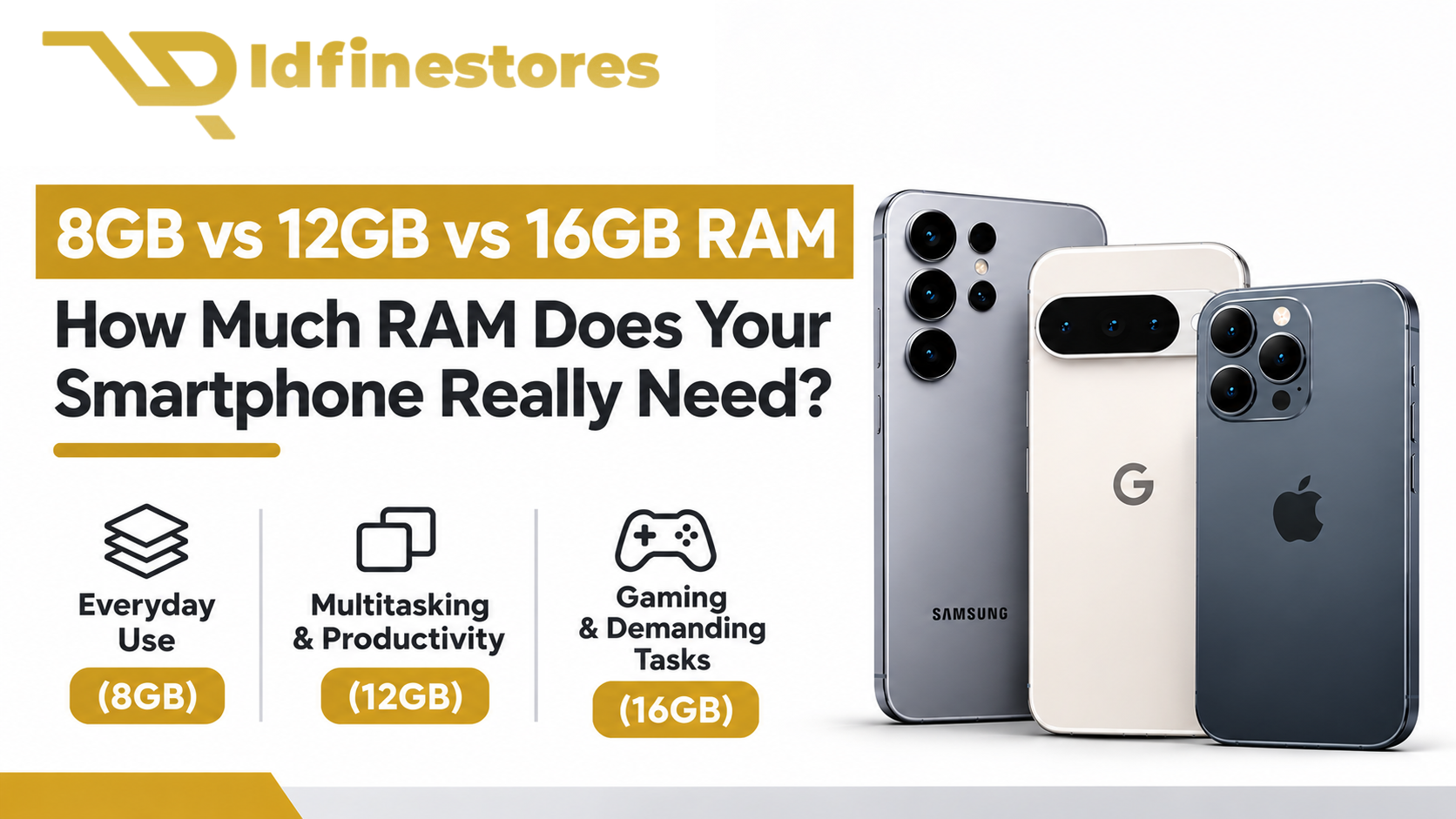
12. Which Smartphone RAM Capacity Should You Buy?
Let’s bring everything together.
| RAM configuration | Suitable usage | Buying guidance |
|---|---|---|
| 8GB | Everyday applications, browsing, social media, photography and many games | A sensible choice for many users |
| 12GB | Frequent multitasking, demanding applications and heavier gaming | A strong balance for demanding users |
| 16GB | Intensive workloads, supported advanced applications and greater memory headroom | Best considered when the extra capacity is useful |
These are practical buying guidelines, not universal performance guarantees. A particular phone’s chipset, software, memory management and application support can change the experience.
Our final recommendation
If you are buying a smartphone for everyday use, do not feel pressured to purchase the highest RAM configuration available.
An 8GB device with good hardware and software optimisation can serve many customers very well.
If you regularly multitask or use demanding applications, consider 12GB.
If you have more demanding workloads and the specific phone makes good use of the additional memory, 16GB is worth considering.
For Samsung Galaxy, Google Pixel and Apple iPhone buyers, always compare the exact model, regional variant and complete specification before making your decision.
Why Buy from Idfinestores?
At Idfinestores, we believe buying technology should begin with understanding the technology itself.
We educate customers through practical technology articles, product comparisons and demonstrations, helping them understand what they are buying rather than making decisions based on specifications alone.
Our team brings technology knowledge and product guidance to the buying experience. We carefully manage our product selection, pricing and customer service under one business, rather than operating as a multi-vendor marketplace.
We also believe customer support should continue after delivery. Our team remains available to assist with relevant product questions and customer concerns.
Our purpose goes beyond selling gadgets. We want to improve how people understand, choose and buy technology.
Buy Your Next Smartphone from Idfinestores
Whether you are looking for a Samsung Galaxy, Google Pixel, Apple iPhone or another smartphone, explore our collection and let us help you find a device that matches your needs and budget.
Buy all your smartphones from Idfinestores.
Idfinestores — Where Tech Meets Excellence.
Frequently Asked Questions
1. Is 8GB RAM enough for a smartphone?
For many everyday users, yes. It can support messaging, browsing, social media, photography, streaming and many mobile games. The actual experience depends on the phone’s processor, software and workload.
2. Is 12GB RAM better than 8GB?
It provides more physical memory capacity and can be useful for demanding multitasking. However, the difference may not be noticeable for customers who mainly use everyday applications.
3. Is 16GB RAM necessary for a smartphone?
Not for everyone. It is more relevant to customers with demanding workloads, intensive applications or a preference for additional memory headroom.
4. Does Samsung RAM Plus increase physical RAM?
No. RAM Plus uses a portion of internal storage as virtual memory. It does not increase the physical RAM installed in the device.
5. Why do iPhones perform well without advertising RAM?
Apple integrates its processors, iOS and hardware, and its main product specifications do not routinely advertise RAM capacity. Overall performance cannot be judged by RAM figures alone.
6. Does more RAM improve smartphone camera quality?
Not automatically. Camera quality depends on the camera hardware, image processing, software and other factors. RAM can help support demanding processing tasks, but it is not a direct measure of camera quality.
7. Does RAM affect battery life?
RAM is one part of a smartphone’s power consumption, but battery life is influenced by many factors, including the processor, display, network connection, applications and battery capacity.
8. What is the difference between RAM and 256GB storage?
RAM is temporary working memory used while applications operate. The 256GB refers to internal storage for saving applications, photographs, videos and files.
9. Should I buy a 12GB Samsung or an 8GB iPhone?
There is no universal answer. These phones use different operating systems, processors and memory-management approaches. Compare the exact models, features, performance and your intended usage.
10. How can I confirm the RAM capacity of a smartphone before buying?
Check the manufacturer’s official specifications for the exact model and regional variant. Do not rely only on a seller’s headline description or a virtual RAM figure.